Beauty Spots · County Antrim
The Giant's Causeway & Causeway Coast: Legend, Geology & the Best Walks
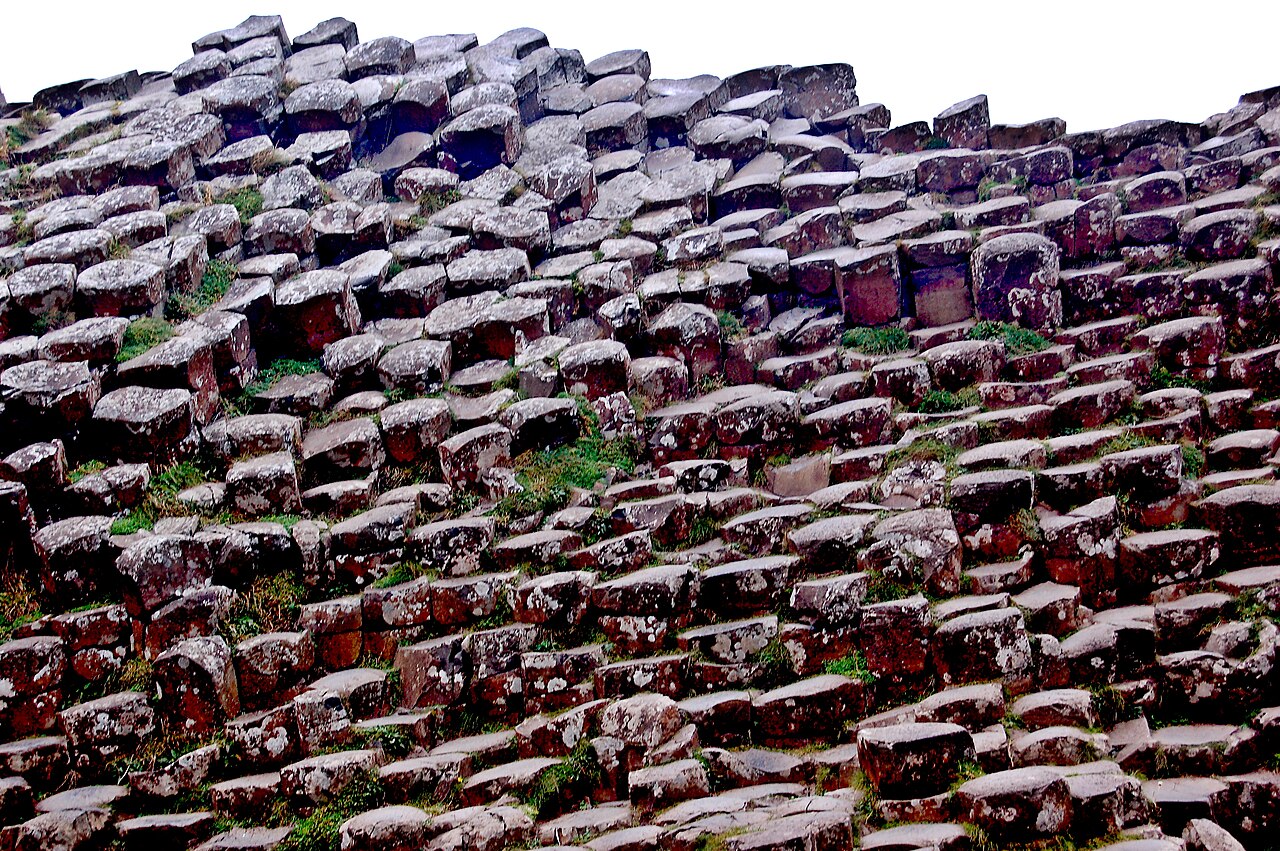
The Giant's Causeway lies on the north coast of County Antrim, near Bushmills: an area of about 40,000 interlocking basalt columns, most of them six-sided, stepping down into the sea like a giant's pavement. It was declared a UNESCO World Heritage Site in 1986.
Why The Giant's Causeway & Causeway Coast Is Special
There is nothing else like the Giant's Causeway in the British Isles. Walking over its columns, with the cliffs above and the Atlantic surf around you, is an unforgettable experience.
The whole Causeway Coast around it is magnificent, with ruined castles, a rope bridge, white beaches and little harbours.
The History of The Giant's Causeway & Causeway Coast
The columns are the result of an ancient volcanic eruption, part of the great North Atlantic volcanic province. As the thick lava flows cooled and shrank, they cracked into regular columns, much as mud cracks as it dries.
Legend tells a different story: that the giant Finn McCool built the causeway to cross the sea and fight his Scottish rival Benandonner, and the similar columns of Fingal's Cave on the Scottish island of Staffa are said to be the other end.
The Causeway became a national nature reserve in 1987, and it is cared for by the National Trust, with a visitor centre above the stones.
What to See & the Best Walks at The Giant's Causeway & Causeway Coast
Walk down to the stones from the visitor centre, see the Wishing Chair and the Organ, then climb the Shepherd's Steps to the clifftop path for the view down onto the causeway.
Visit the ruins of Dunluce Castle on its cliff to the west, and cross the Carrick-a-Rede Rope Bridge to the east (book ahead). Walk the Causeway Coast Way along the cliffs and beaches.
Wildlife at The Giant's Causeway & Causeway Coast
Seabirds such as fulmars and kittiwakes nest on the cliffs, and seals and dolphins are sometimes seen offshore. Rathlin Island, a short ferry ride from Ballycastle, has one of the largest seabird colonies in the British Isles.
Gardens, Countryside & Antiques near The Giant's Causeway & Causeway Coast
See the Giant's Causeway and Causeway Coast and Causeway Coast AONB listings, and the RSPB Rathlin Island Seabird Centre. Creative Gardens Bushmills is close by.
Our guide to Ballintoy covers the harbour and the rope bridge, and the Glens of Antrim are further east; see the Glens of Antrim.
The Giant's Causeway & Causeway Coast Through the Seasons
Spring and early summer bring seabirds to the cliffs and Rathlin. Summer is the busiest season, so come early or late. Autumn and winter bring wild Atlantic seas and spectacular sunsets.
Getting to The Giant's Causeway & Causeway Coast
The nearest railway stations are Coleraine and Portrush, with buses along the coast. There is parking at the visitor centre.
The Giant's Causeway & Causeway Coast: Questions & Answers
How many columns are there at the Giant's Causeway?
About 40,000 interlocking basalt columns.
When did the Giant's Causeway become a World Heritage Site?
In 1986.
Our Advice
Our advice: Arrive early in the morning or late in the afternoon, walk the clifftop path as well as the stones, and combine the visit with Dunluce Castle.
Facts checked October 2026. Sources: Wikipedia: Giant's Causeway · nationaltrust.org.uk. Opening times and prices change, so please check before you travel.